

The inspector called it a house with good bones, which Erin had learned was what people said when everything else was falling apart.
It was a 1924 bungalow on a street of 1924 bungalows, with a deep front porch and a crooked chimney and a kitchen that someone in 1978 had done terrible things to with orange laminate. She bought it in April, three weeks after the divorce was final, with the money from her half of the house she and Richard had lived in for eleven years. Her friends thought she was out of her mind. Her mother said, Alone? All that work, alone? and Erin said yes, alone, with a brightness she did not feel.
She was thirty-seven. She taught sophomore English. She knew a great deal about Gatsby and almost nothing about load-bearing walls.
Theo Banks came recommended by a woman in her book club who said, He’s expensive and he’s worth it and he will not let you do anything stupid. He showed up for the estimate in a faded green work shirt and boots that had seen a lot, a tall, solid Black man in his early forties with a gray-flecked beard and forearms like bridge cables, and he walked through every room of the house without saying anything for twenty minutes. He knocked on walls. He lay on his back on the bathroom floor and looked up into the vanity. He went down to the basement and was gone so long she worried.
When he came back up he had cobwebs in his hair and a look on his face she would come to know very well, a kind of quiet, private delight.
“Somebody loved this house,” he said. “A long time ago. You can tell from the joinery.” He brushed the cobwebs off. “I’d like to make somebody love it again.”
She hired him on the spot.
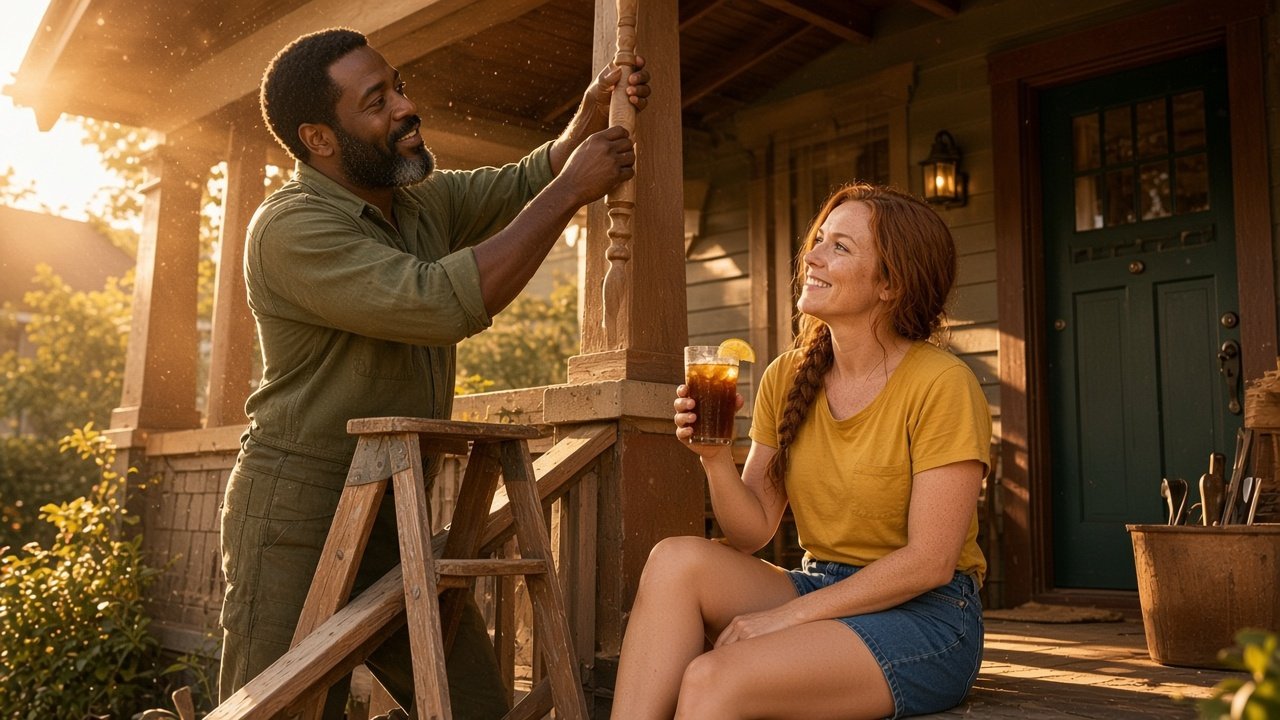
All that summer, Theo was there.
He came at seven in the morning, six days a week, his truck in her driveway before her alarm went off. He tore out the orange laminate. He found the original fir floors under three layers of linoleum and made a sound when he pulled up the first corner that she could only describe as reverent. He rebuilt the porch, board by board. He explained things to her—why you sister a joist, what a mortise was, why the old wavy glass in the front windows was worth saving—and never once made her feel stupid for asking.
She was off for the summer, so she was there too. At first she stayed out of his way. Then she started bringing him iced tea at ten and again at three. Then she started sitting on the porch steps while he worked, grading summer-school essays or pretending to, and they talked.
He’d grown up in Gary, the son of a steelworker who’d built furniture in the garage on weekends. He’d been married for twelve years. No kids—they’d tried, and it hadn’t happened, and somewhere in the trying they’d stopped being kind to each other. “We were good people,” he said, sanding a porch spindle in long, patient strokes. “Just not good together, by the end. That’s the saddest kind.”
“Yeah,” Erin said, and didn’t say anything else, and he looked up at her and nodded like she had.
She noticed things about him. She couldn’t help it. The way the sweat darkened his shirt down the spine in the August heat. The way he talked to the wood, under his breath, when a piece wasn’t cooperating. The way his big scarred hands were so careful with small things—a brass hinge, a pane of hundred-year-old glass, the hummingbird that got trapped on the porch one afternoon, which he cupped in both palms and carried out to the yard and released, then stood watching it go with that same private delight.
She noticed, too, how he looked at her sometimes when he thought she wasn’t looking. And how he always, always looked away.
At night, alone in the half-finished house with the windows open and the cicadas going, she thought about him. About those hands. About what it would be like to be held by a man that size, that steady. Once, lying in bed with the box fan blowing and sweat on her collarbones, she slid her hand between her legs and thought about him so specifically—his weight over her, his beard against her throat, how he would feel, how much of him there would be—that she came biting her own wrist, and lay there afterward with her face burning, as if he could somehow know.
He never crossed the line. Not once. Not even close.
In September she went back to school, and he kept working, and she came home every afternoon to find something new: the kitchen cabinets hung, the clawfoot tub reglazed, the dining room glowing with fresh plaster. The last job was the built-in bookshelves on either side of the living room fireplace, which had been painted over so many times the doors wouldn’t close. He stripped them down to the original quarter-sawn oak and refinished them by hand, and when they were done, on the second Friday in October, he called her into the room to look.
They were gold in the lamplight. The grain moved like water.
“Oh,” Erin said, and put her hand over her mouth, and burst into tears.
He stood there awkwardly with a rag in his hand. “That a good cry or a bad cry?”
“Good,” she managed. “So good. It’s just—it’s done. It’s actually done.”
“It’s done,” he agreed quietly.
She wrote him the last check at the kitchen table. He folded it into his shirt pocket without looking at it. He loaded his tools into the truck while the sun went down, and she stood on the new porch with her arms wrapped around herself, and he came up the steps one last time and stopped in front of her.
“Erin,” he said. “It’s been a real pleasure.”
“For me too.”
He seemed about to say something else. He didn’t. He went down the steps, and got into his truck, and drove away, and she went inside and sat down on her beautiful refinished floor and cried for a different reason entirely.
He came back eight days later, in the rain.
It was a Saturday night, nearly ten. She was in leggings and an old cardigan with a glass of red wine, reading on the couch with her feet tucked under her, the bookshelves full now with all the books that had been in boxes since April. When the knock came she thought it was a neighbor. She opened the door and he was standing on the porch in a dark rain jacket with water running off the hood, and he looked—nervous. She had never seen him nervous.
“Hi,” Theo said.
“Hi.” Her heart was going wild. “Is something—did something break?”
“No. Nothing broke.” He pushed the hood back. Rain beaded in his beard. “I’m off the job now. You paid me. I’m not your contractor anymore.” He took a breath. “So I wanted to ask if I could take you to dinner sometime. And if the answer’s no, that’s okay, and I’ll go. But I’ve been wanting to ask you since about June, and I couldn’t, and I’ve been driving around for an hour working up the nerve.”
Erin stared at him.
“Since June,” she repeated.
“About the second week of June. You were wearing a yellow shirt and you told me about the Gatsby essay where the kid argued Nick was in love with—”
She took his face in both her hands and pulled him down and kissed him.
He made a sound against her mouth, surprised and deep, and then his arms came around her and lifted her clean off her feet. He was wet from the rain and she didn’t care. He walked her backward into the house and kicked the door shut behind him, and they stood in her front hall kissing like teenagers, his cold hands on her back under the cardigan, her fingers in the damp collar of his jacket.
“Dinner,” she said against his mouth. “Yes. Dinner. Later. Theo—”
“Yeah.”
“Stay. Please stay.”
He pulled back just enough to look at her. His eyes were very dark and very serious. “You sure?”
“I’ve been sure since about June,” she said, and he laughed—that low, delighted laugh she’d been hearing all summer through the open windows—and kissed her again.
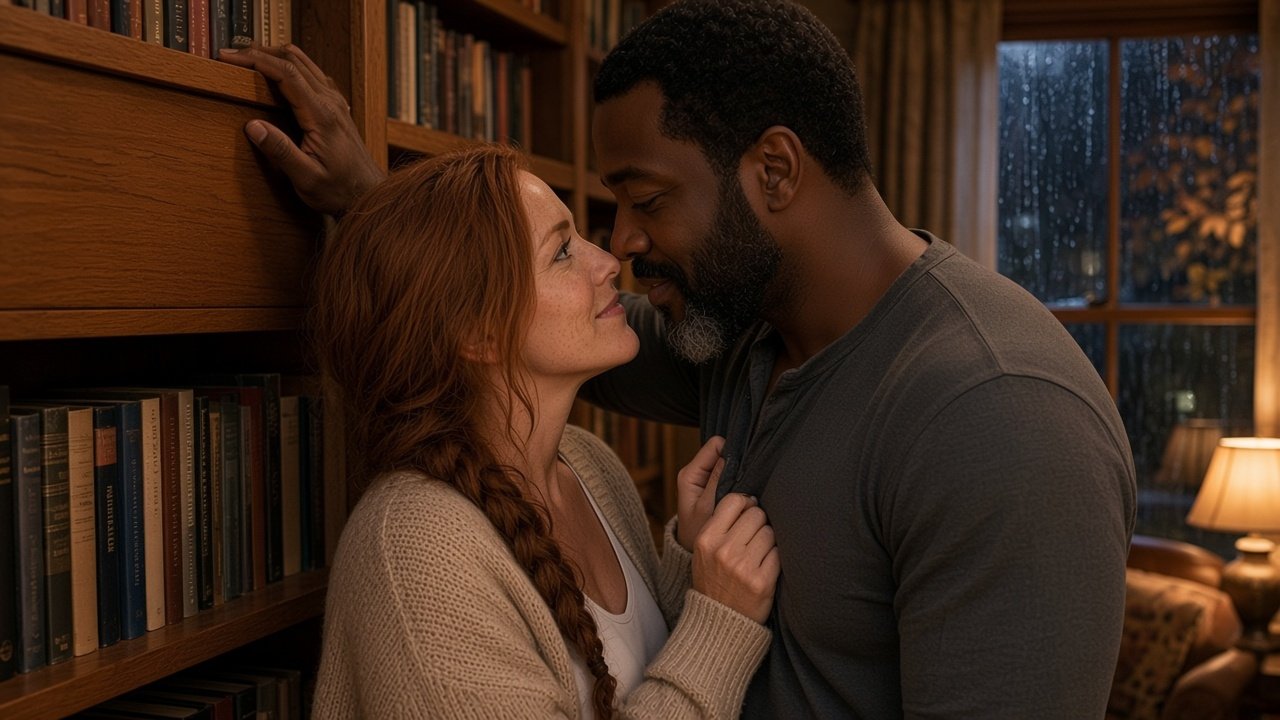
They didn’t make it to the bedroom. They made it to the living room, where the lamp was on and the fire she’d built earlier was down to coals, and he pressed her back against the bookshelves he’d made with his own hands and kissed her throat while she struggled out of the cardigan. He set his palm flat on the shelf above her head, and she felt the whole length of him pressed against her, hard and solid, and when she rocked her hips into his she felt something else too, thick and heavy against her belly through his jeans, and her breath caught.
“Theo,” she whispered.
“I know.” His voice was rough. “We’ll go slow.”
He peeled her shirt over her head. She wasn’t wearing a bra—she’d been reading on the couch on a Saturday night, alone—and he went very still, looking at her in the firelight. Then he bent and took one nipple into his mouth, and then the other, his beard scratching softly across her skin, and her head fell back against the oak with a thunk that made them both laugh.
“Careful with those,” he murmured. “Took me three weeks.”
“Shut up,” she said, and pulled his shirt off.
She’d seen his arms all summer. She’d imagined the rest. Imagination hadn’t done it justice: his chest broad and dark and heavy with muscle, a few gray hairs on it, a long pale scar along his ribs from some job twenty years ago. She ran her hands over him, mapping him, her white fingers spread across his dark skin, and watched him close his eyes and shudder at her touch like a man who hadn’t been touched in a long time.
“When was the last time,” she asked softly.
“A while.” He opened his eyes. “You?”
“A while. Longer than that.” She reached for his belt. “Let me.”
She opened his jeans and pushed them down with his boxers and he stepped out of them, and then he was standing naked in front of her in the firelight and she simply stared. He was huge. Thick and dark and heavy, already hard, curving up from a nest of black hair, so long and so wide that she actually laughed, a short disbelieving breath.
“You’ve got to be kidding me,” Erin said.
He grinned, a little shy. “Should’ve put that in the estimate.”
She sank to her knees on the floor he’d restored and took him in both hands—it took both hands, and there was still more of him—and stroked him slowly, watching his face. Then she leaned in and put her mouth on him. She couldn’t take much: the head, and a few inches past it, stretching her lips wide, her jaw aching almost immediately. She didn’t care. She worked him with her hands and her tongue and listened to him groan, felt his fingers slide into her hair and hold, gentle, felt his thighs shake.
“Erin,” he said. “Erin. Come here. I want to be inside you.”
He lifted her up, and stripped the leggings off her, and laid her down on the thick wool rug in front of the fire. He found a condom in his wallet—”Optimist,” she said, and he said, “Since June”—and rolled it on, and she watched the latex stretch tight over him and pressed her thighs together on a shiver of nerves and want.
He didn’t go straight to it. He kissed down her body first, slow, the way he did everything, and settled between her legs and put his mouth on her until she was arching and gasping and pulling at the rug, until she came against his tongue with her heels drumming on the floor and her whole body shaking. Only then did he move up over her, braced on his forearms, his weight a warm wall above her, and look down into her face.
“Tell me if it’s too much,” he said.
“I will.”
He pressed in. Slowly. So slowly. She felt the broad head of him spreading her open and her mouth fell open with it, a long, low moan pulling out of her. It was a stretch unlike anything she’d ever felt—deep and full and right at the edge of pain without ever crossing over—and he stopped every inch or so and waited, kissing her forehead, her eyelids, until she breathed and nodded and pulled him deeper with her hands on his hips.
“Oh God,” she said. “Oh God, Theo, there’s so much of you.”
“You’re doing good, baby. So good.”
When he was finally all the way inside her, they both stopped and just breathed. She could feel him pulsing. She could feel him everywhere, in her belly, in the backs of her knees. She looked down the length of their bodies in the firelight, at her pale thighs splayed wide on either side of his dark hips, and the sight of it went through her like current.
He started to move.
He made love to her the way he’d sanded those shelves: long, patient, even strokes, drawing all the way back and pressing all the way in, over and over, until she lost track of time. Her moans came in a rhythm with him. Her hands slid on his sweat-slick back. When she started begging—more, please, faster—he gave it to her, and the long slow strokes turned deep and hard, his hips driving into her, the rug burning her shoulders, her breasts bouncing with every thrust. She wrapped her legs around his waist and locked her ankles and held on. The fire popped. Somewhere a book slid off a shelf and thumped to the floor and neither of them noticed.
“Look at me,” he said, and she did, and came with her eyes locked on his, her whole body seizing and shaking, her toes curling against the backs of his thighs, his name broken in her mouth.
He rolled them. Put her on top, his big hands spanning her hips, and helped her sink down onto him. Like this she could see all of him—every inch disappearing into her, slick and dark, the stretch of her around him—and she rode him slowly at first, rising and falling with her hands braced on his chest, and then faster as she found the angle, her head thrown back, her hair sticking to her neck. He watched her like she was the most beautiful thing he’d ever built. He reached up and covered her breasts with his hands. He thrust up to meet her, and the first time he did it she cried out loud enough to startle herself.
“That’s it,” he groaned. “That’s it, Erin, take it, take all of it—”
She came again on top of him, grinding down, her thighs trembling so hard she couldn’t hold herself up, and he caught her, sat up with her in his lap and wrapped his arms around her and held her tight against his chest while he thrust up into her, short and deep and fast, until he buried his face in her neck and shuddered and came with a long, low groan she felt in her own bones.
They stayed like that a long time. Her in his lap, wrapped around him. His arms locked around her back. The fire down to embers. The rain still going outside, steady and soft.
“I wanted you all summer,” she said into his shoulder.
“I know,” he said. “I could tell. That’s why I couldn’t.”
“Why?”
He pulled back to look at her. “Because you were paying me to fix your house. And you’d just come out of something hard. And I didn’t want to be one more thing you had to figure out.” He brushed her hair off her forehead. “I wanted to be a thing you got to choose.”
She looked at him for a long moment. Then she kissed him, softly.
“I choose,” she said.

In the morning the rain had stopped and the street was covered in wet gold leaves. She made coffee in the kitchen he’d built, barefoot on the floor he’d found, and brought two mugs out to the porch, where he was sitting on the swing he’d hung in August, in his jeans and nothing else, looking at the house across the street with a critical eye.
“Their gutters are a mess,” he said.
“Don’t you dare.”
He laughed and took his coffee and put his other arm around her, and she tucked her feet up and leaned into him, his skin warm against her cheek, the swing creaking gently under them.
“So,” she said after a while. “Dinner.”
“Dinner,” he agreed.
“Tonight?”
“Tonight.” He kissed the top of her head. “And tomorrow, if you want. And the day after that.”
She looked at the house: the porch he’d rebuilt, the wavy old glass in the windows catching the morning sun, the crooked chimney he’d decided, after long deliberation, to leave crooked, because it had character.
“Good bones,” she said.
“The best,” Theo said, and she could hear him smiling, and she knew he didn’t mean the house at all.